TLDR: If you're catching up on launch week, skip to the lineup.
Product tools have always been good at one thing: gathering your stuff into one place and making it tidy. The actual product work, the thinking and deciding and digging, was always still on you. And in my experience, no product manager ever gets all the discovery done they wish they could.
So I've been spending a lot of time recently training a product agent to actually do the job. The goal is to automate most of the work, while keeping a human in the loop at moments that call for it.
Experience gives me a spidey sense for whether I'm in the territory of an annoying product task that we'd be happy to get off our plate vs whether we've crossed into a part of the domain that requires human involvement and creativity.
Zoom out and the whole thing is a loop: the agent finds the idea most likely to move your metric, hands it to your coding agent, and learns from what ships. Competitive analysis is just one playbook inside that loop, but it's a good one to start with because it shows you how the agent thinks. So let's take it as our example: end-to-end competitive analysis.
The problems worth solving
One of the things I hear most often when I interview product managers is that they know market research and competitive analysis are important, but that the work consumes a lot of time, can be tedious, and requires constant repetition to ensure it doesn't drift out of date.
To solve the problems I heard, the playbook needed to achieve the following:
- Solve the blank page problem fast; a lot of teams don't have existing competitive analysis they're updating. Starting from scratch takes days, which basically means backburnered forever.
- Do away with the pain of manual research. Searching the web and internal docs for prices and features is tedious, and then you need to organize it all so you can actually analyze it.
- Make it easier to know what's changing in the market; AI leads to competitors launching faster, which can catch us by surprise.
- Let the human steer the process when needed without giving up all the automation gains in the process.
The hard part wasn't the skills
Teaching the agent how to think like a product manager turned out to be relatively easy. Agent skills and frontier models can take us pretty far on that front. I guess I say it's easy in part because I did that job for decades already.
Where things get interesting is the context engineering. There are so many tiny pieces of information that product people have in their brain and spontaneously apply to guide their work and decision making. Just because an agent knows how to do market research and competitive analysis doesn't mean it has the right context to do it for your team without making rookie errors.
To us, it all feels pretty obvious: the current OKR, our existing features, the trend everyone is talking about on Reddit, the part of the stack our team works in. Coding agents can often get away without knowing all this if they get a clean spec, but a product agent needs to know it, check when it changes, and call on it on demand. We're all building these systems somehow. One way is an elaborate structure of markdown files that can turn something like Claude Code into a product agent. It's a powerful pattern, and I like using it myself, but even with all that set up the agent hit limits. It would look up data and find some things, but the lack of structure in a growing library proved problematic.
And then there was always something missing from the pile of markdown files. It was in Notion, or wherever the rest of the team actually wanted it. So you either migrate it to your markdown empire or bring in MCP servers to connect to the data, but that's a whole other set of challenges: the agent has to learn how your team uses those tools and where things live.
As we went forth solving these problems, we realized the product domain called for far more structure than markdown files in a repo. The agent needed not just domain skills but tools to progressively query and explore the full product domain. That is what Revelica has now become: a product platform that serves up all the data so an agent can intuitively explore it, understand the common sense things we want it to, and help us curate and maintain it all, without forcing yet another migration from our current stack into Revelica or a heap of markdown files. Building it was a long odyssey, and the platform and domain modeling was the Herculean part. We had to train the agent to use it through tools at every turn, coaching it where to look and when across the chaos that is product.
What it looks like now
So now, when you do competitive analysis, the agent already knows your business model. It knows who your ICP is. It can use those things to naturally find emerging competitors, and to know who you already analyzed, because that is data native to Revelica that it's trained to work with. When you onboard, the agent eliminates the blank page problem and then makes it easy to iterate on what's there. No more painstaking copy/paste, or searching for things you did in a previous AI chat. Just say "I found a new competitor, let's add them to the market map." The product agent will get it done using the tools it prefers: native tool APIs, including MCP tools for the parts of your stack you want to connect. And then you can get back to using the tool you prefer: a human-first UI rich with graphs, multiplayer capabilities, and realtime updates any time things change regardless of whether that change was performed by a teammate, an agent, or even a colleague working with a coding agent and using the Revelica MCP server.
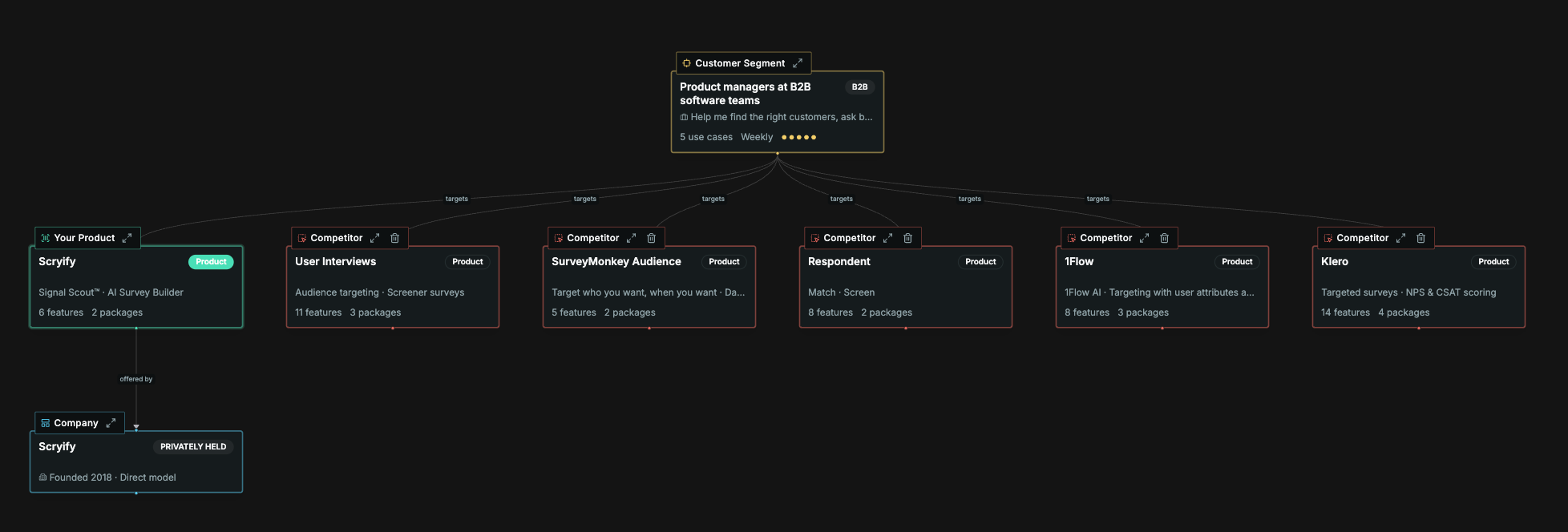
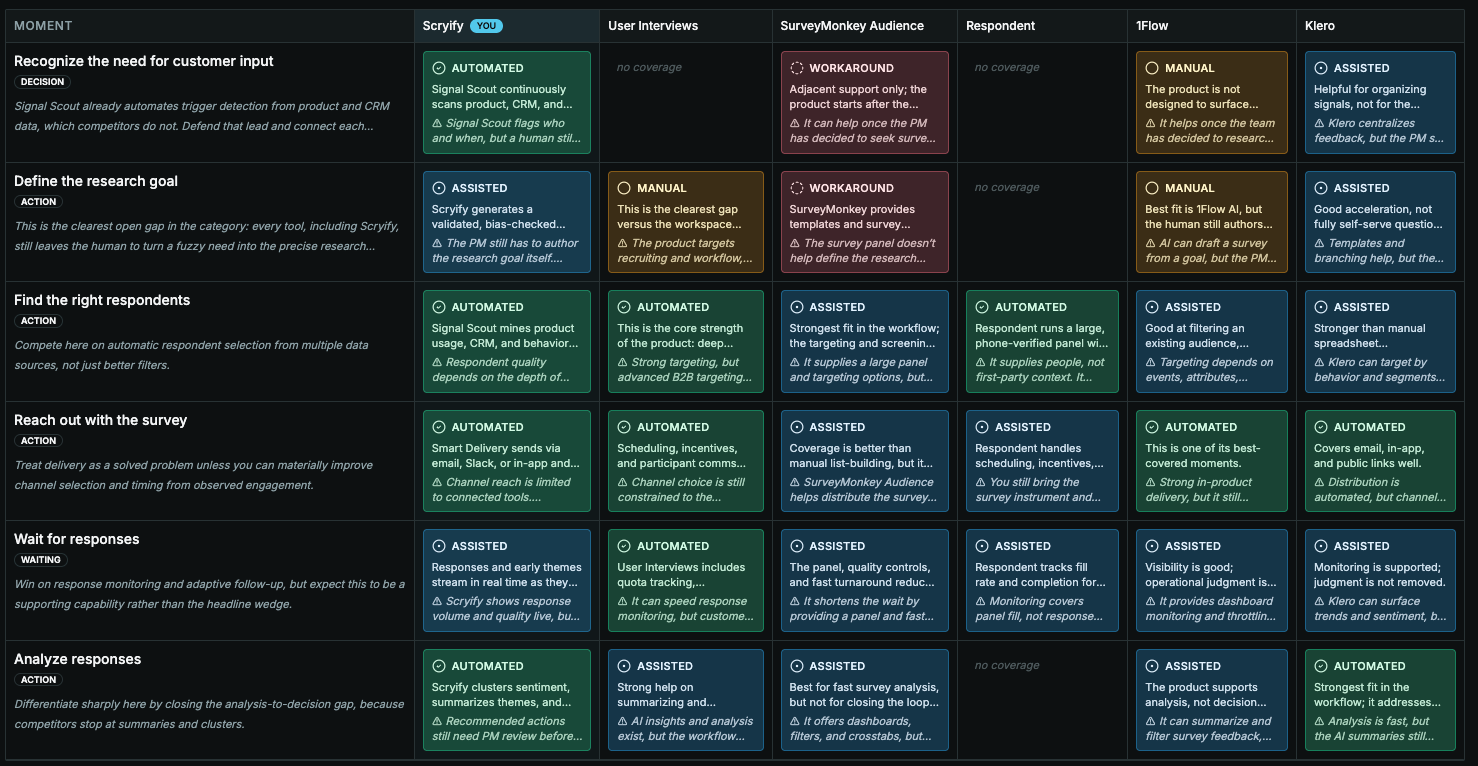
Finally, we reached the point where we solved the problems we set out to solve:
- We have fully automated market research and comprehensive coverage analysis, all from two onboarding inputs: the name of your company and a link to your website. There's the blank page problem gone.
- The manual research problem is gone, both at the blank page stage and beyond. The product agent can work with the raw data you have: a PDF, a link you found, a Confluence document, a Notion page, a bunch of markdown files, or simply something you heard and want to write down. Revelica handles all those things and makes sure they get organized into sources, findings, citations, and updated competitive analysis.
- Great, but what about that problem where things are constantly changing? Just go to the market map and ask the agent to "let's find out if anything changed recently." Let the agent do what it's good at, finding data, transforming it, categorizing it, and summarizing the part that actually matters to you.
- The last problem is how to know when a human should be involved. We know the product workflows have specific ebbs and flows, and put little touches such as "Add competitor" right in the place you might need it. Our agent is prompted in its training to stop and ask the user for guidance at key moments, and it even has a specialized tool to do that, and will stop and wait for an answer before churning away on something that it knows depends on the question at hand.
Read where your data already lives
Remember the stuff that was always missing from the markdown pile because it lived in Notion or Jira instead? The agent reads where your data already is. We built secure integrations with Jira, Notion, Linear, GitHub, PostHog, and Slack, all over MCP and OAuth, so it works with the tools your team already uses. No migration, and it inherits your permissions, so it only ever sees what you can see.
It can write back to those tools too, when the workflow calls for it. But that's a conversation for another day.
Still a team sport
I want to be clear about one thing: this isn't a black box you fire off and hope. The agent is a new member of the team. It does the job with you, not instead of you. You steer it, you collaborate with it, and it stops to ask when it hits a fork that needs your call. Product is still a team sport. The agent is just a teammate who never runs out of time for the tedious parts.
Where this is headed
And all of this is just upstream of the part your engineers care about. When an idea is ready to build, a coding agent picks it up with tight context over our MCP server, ships it, and writes back what shipped. Then the agent checks your analytics to see if the bet actually moved the metric, and uses the answer to sharpen the next one. That's the loop I'm most excited about, and it's where this is all headed.
If you want to feel it for yourself, onboarding is just a few questions: your company name, your website, and your team's current OKR. From there the agent gets to work, framing the market, running competitive analysis, building a customer experience map, brainstorming new ideas, framing a bet, and running an experiment on the most promising idea. All so you can get a feel for how quickly the product agent can move.
Launch week
A picture is worth a thousand words, so each playbook gets a guided walkthrough with screenshots from the Canvas. I'm covering one a day, lighting up the links here as each lands:
Randall