TLDR: If you don't want to read a story about AI native product discovery, Revelica is in open beta now!
I've been using Claude Code to work on Revelica for months now. I use it for everything: new features, debugging, and non-coding product discovery work. Over time I noticed that the best results in terms of quality software came when I spent a lot of time working with the agent ingesting various types of customer research data, doing UX iterations, and fleshing out an idea in a giant markdown file I came to call a spec. The problem is that I was pretty inconsistent in getting a good result with this process. It was super iterative and because it required that I use one context window to build the spec and at least one more context window to actually implement it, I couldn't rely on the crutch of the meandering spec conversation to guide the implementation agent!
In addition, these spec files got pretty large and context hungry, and they were prone to bloat over time. Decisions I'd make about the UX would cause them to bloat and introduce internal conflicts that reared their head when it came time to implement. Once in a while I'd get so far off the rails on an implementation that I'd just throw it all in the trash and try again, perhaps with a few amendments to the spec.
I was often confused about how to make sure the coding agent respected the customer insights that seemed so obvious to me: customer interview insights, industry and technology nuggets I'd gathered, and my evolving vision for UX borne from continuous conversation with early access customers. Sometimes I'd feed the agent a piece of research data that seemed relevant, and that would help it, but it came at a heavy cost: lost implementation context. It would be a race to see if I could get a meaningful increment of work done before I reached the confused agent with full context window state.
After a comical amount of trial and error, we started to hone in on a way to express a spec that humans and LLMs could both work with. I realized that it emerged like a two-sided coin variant of an old familiar tool: the user story map. In addition to user stories, we added the "why" by specifically calling out the intended customer(s), mapping their UX, and adding the specific opportunity we're focused on solving for them. The result is a visual canvas that we can look at with early access customers and iterate on, plus a structured JSON export that gives the LLM agent an efficient piece of context data that not only lays out user stories, acceptance criteria, and so on, but in a way that shows exactly who the user is and why they care about this in the first place. For good measure we generate some assumptions to get started thinking about the risks you aren't seeing yet.
The story map uses compact pieces of data from other Revelica playbooks to ensure the agent has the context it needs to make good decisions during implementation. To make this work, follow this sequence when setting up Revelica for product discovery.
Step 1: Market Research
When we need to understand the competitive landscape surrounding our value proposition, we run the Market Research playbook. Describe the product space, and Revelica generates a comprehensive value proposition with a summary of your competitive landscape, and detailed reports on your company, ideal customer, solution, and any competing solutions you wish to include.
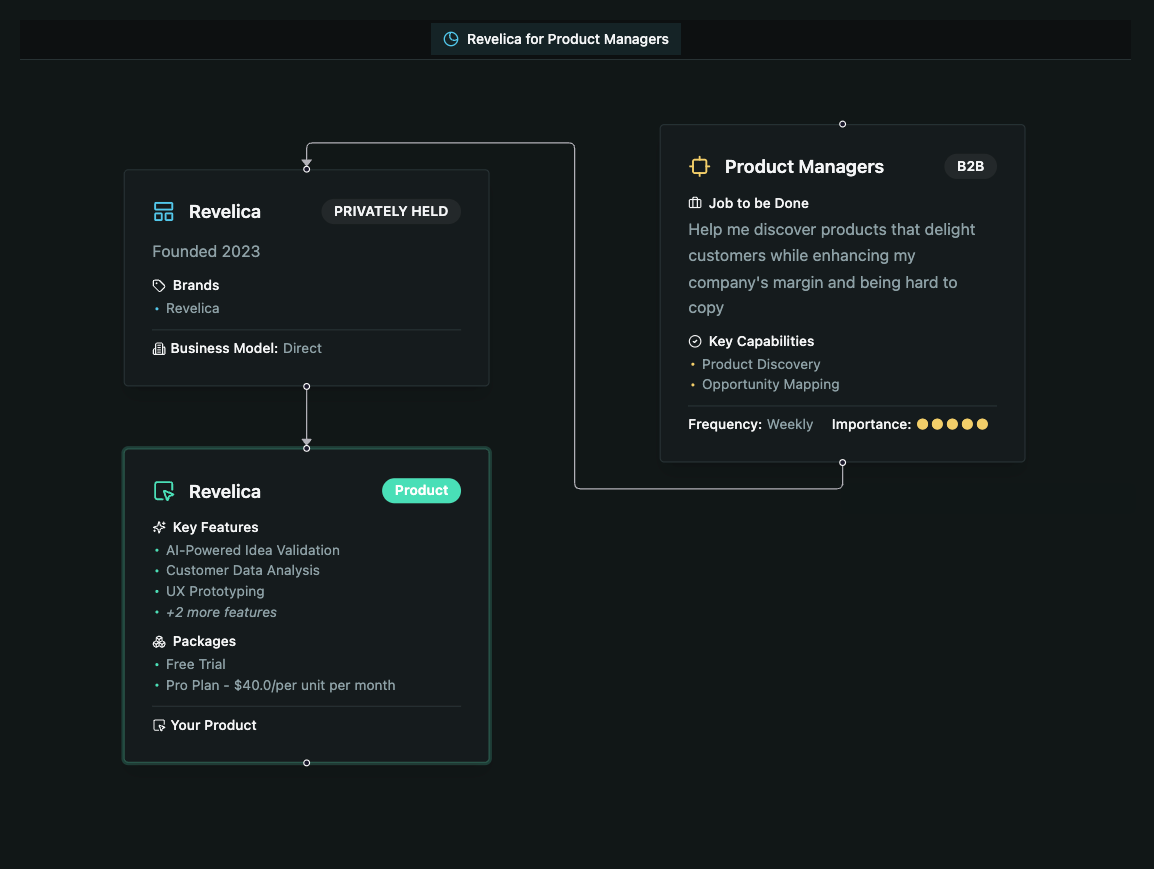
This happens quickly and uses the specific URLs you provide to make sure the research is laser focused. This value proposition becomes part of the foundational context for your story maps.
Step 2: Customer Research
After every customer conversation, we run the Customer Research playbook on the transcript or notes. It generates an interview snapshot along with any opportunities it finds in the conversation. Interview snapshots and opportunities are powerful interview synthesis techniques I learned from Teresa Torres. We even include an experience map showing the customer journey, plus insights and opportunities automatically extracted and connected to the customer segment. This is useful for all those conversations where no one ever seems to get around to doing the synthesis by hand.
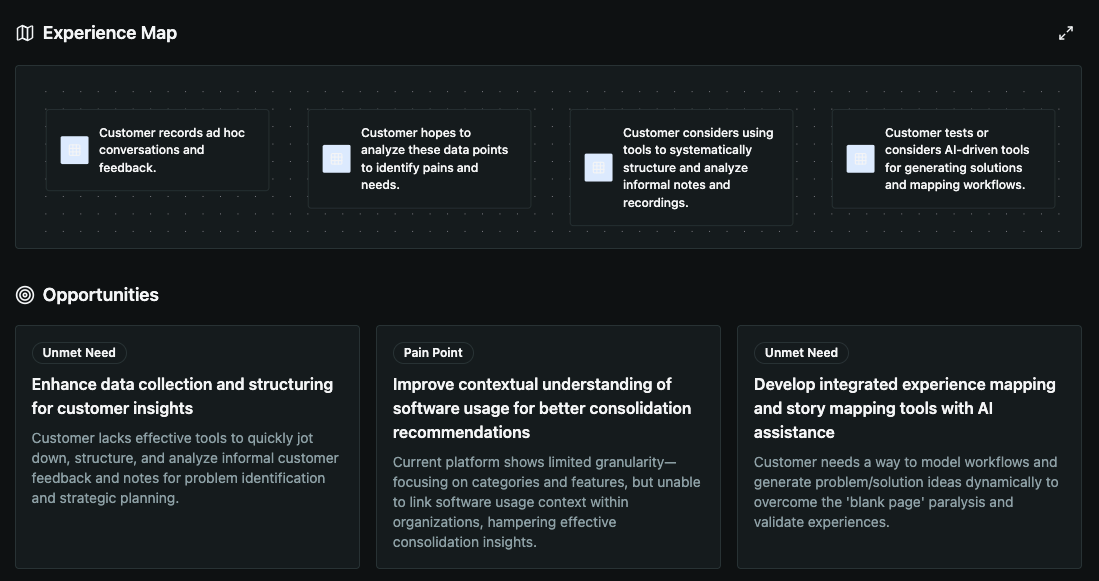
This data is fantastic for summarizing and communicating the results of a customer interview. You may notice, however, that we don't enable our public sharing feature here because we want to protect your customer participants from having their personal details or comments shared outside your company without their knowledge.
Step 3: Story Maps
When it's time to think about solutions, we pick our value proposition (which includes a target customer), then the specific opportunity we want to solve for. Then we give our new feature a name, write or paste the description we have handy, and run the Story Map playbook. It generates a full story map: customer segments as actors, user stories across moments in time, and the assumptions that need to be true for the solution to succeed.
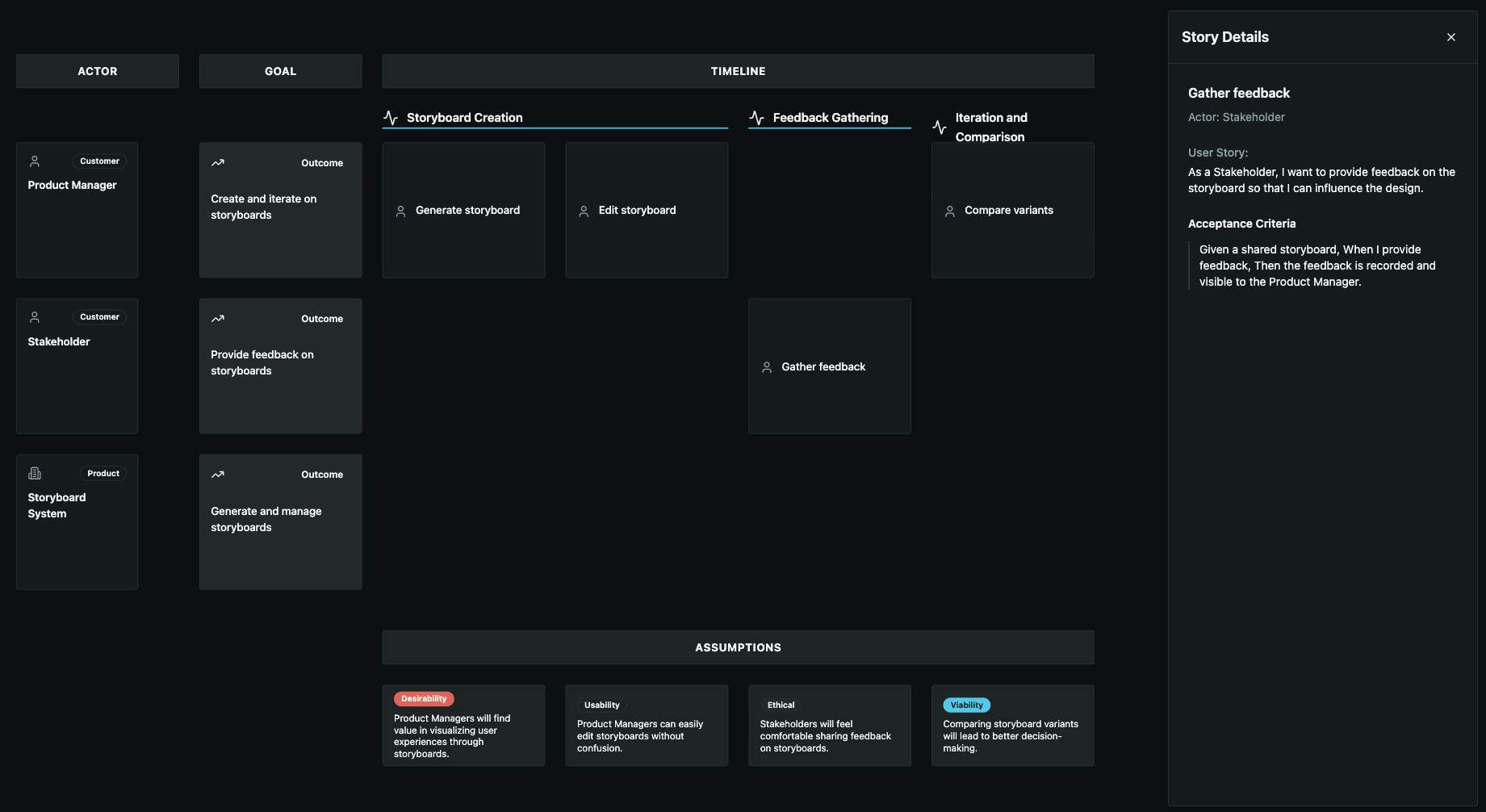
We like this tool a lot because it allows our team to quickly iterate through the "right problem wrong solution" issue we often face. Revelica can turn a single one-liner feature concept into a fully fleshed out story map, anchored to the customer opportunity we want to focus on. This makes it easier to identify assumptions that are rooted in the business or customer context, and to do so immediately for many ideas until you arrive at something strong that you want to dig into further with the team.
Step 4: Specs for Claude Code
Once the story map is to our liking, we export it from the familiar whiteboard view into a structured JSON file which Claude Code gobbles up like candy. All the data you see in the story map is present in a tight bit of context for the agent. Here's a snippet of how that looks:
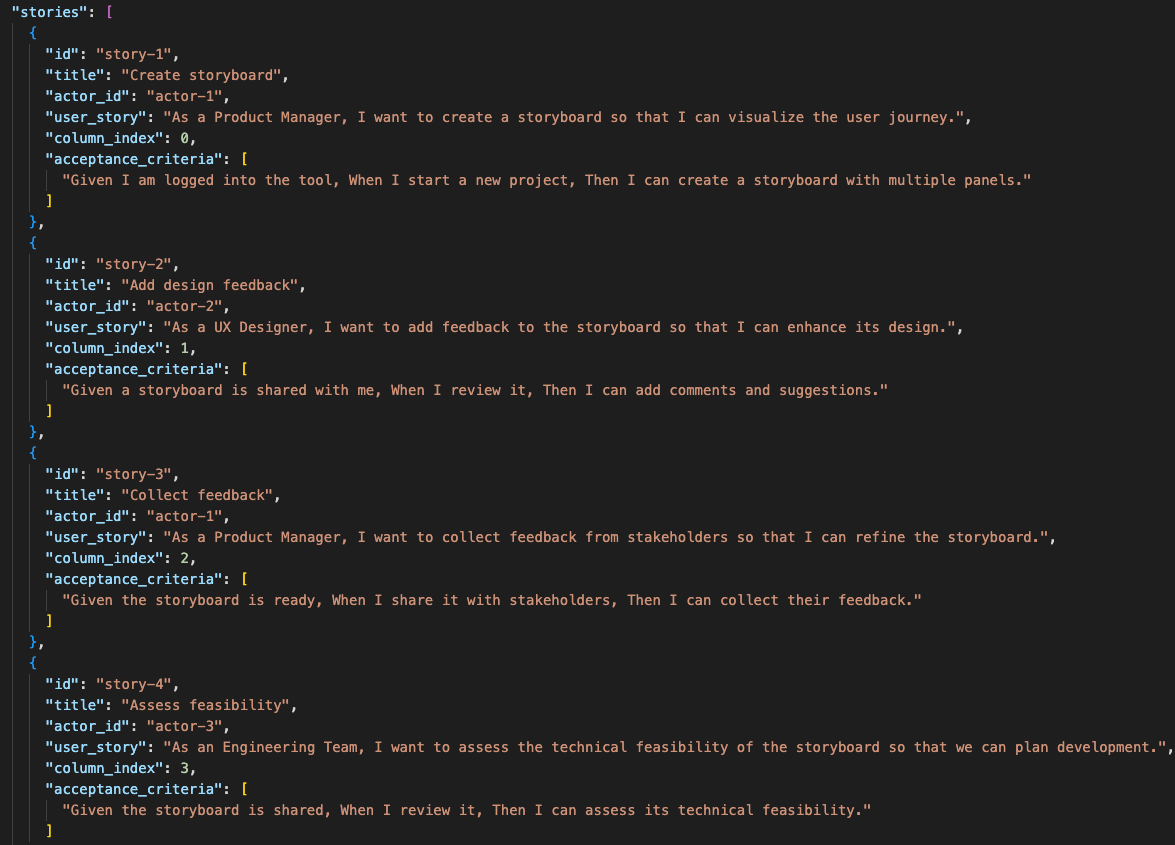
This bit of context engineering gives the what: user stories and acceptance criteria in a sequential flow. It also gives the how: the customer users with the opportunity we're solving, our own solution as an actor with the team's desired outcome, and several assumptions that need to be true for it to succeed as planned. All of this in a compact piece of structured data that Claude Code can easily understand and take action on.
This makes it easier to prototype the solution and quickly identify which assumptions we might want to test before we get carried away. I often use test driven development with the spec as the testable success criteria, which means we can commit tests that are rooted in user behaviour instead of simple functional tests that always seem to let bugs through.
The result? We aren't falling in love with our first idea as much because we figure out that it had a serious flaw pretty quickly. It's a nice little rapid sanity check before we even do things like prototyping.
The Revelica Roadmap as Story Maps
Here are three of Revelica's story maps that represent the output of this workflow and are real features on our product roadmap. Because these artifacts are quick to generate and easy to share with anyone, they are great for getting feedback from stakeholders and customers.
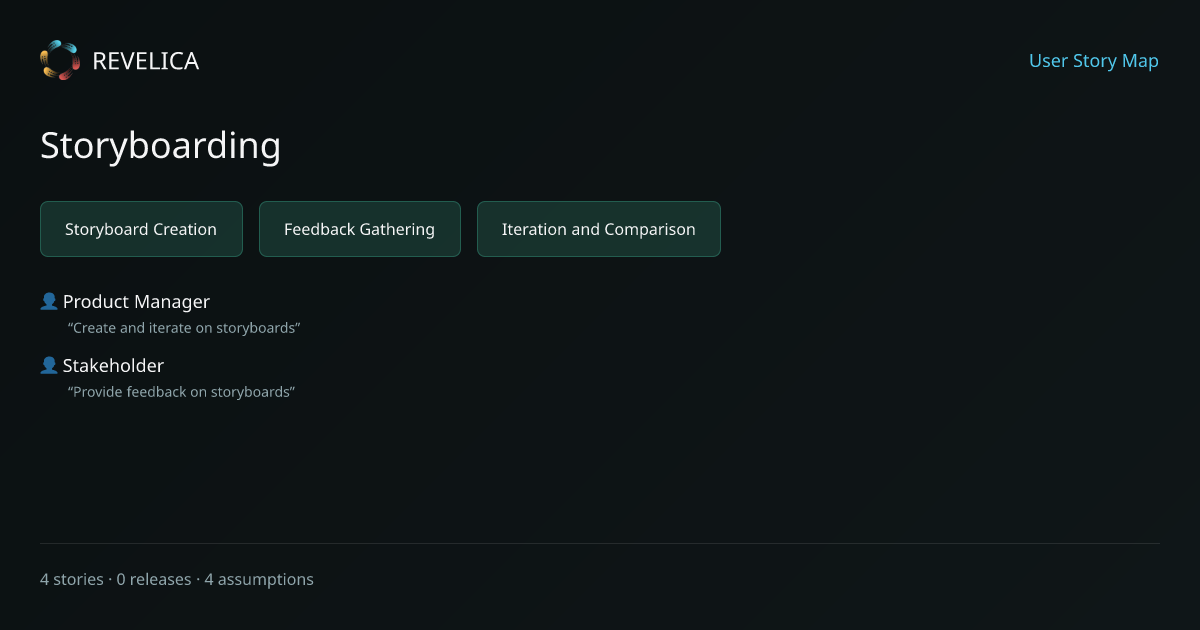
Storyboarding
Generate multimedia storyboards grounded by story maps to prototype the user experience for any idea and then share it with anyone you want to get feedback from. A picture is worth a thousand words for stakeholders, customers, and even for the AI agents that help implement the idea.
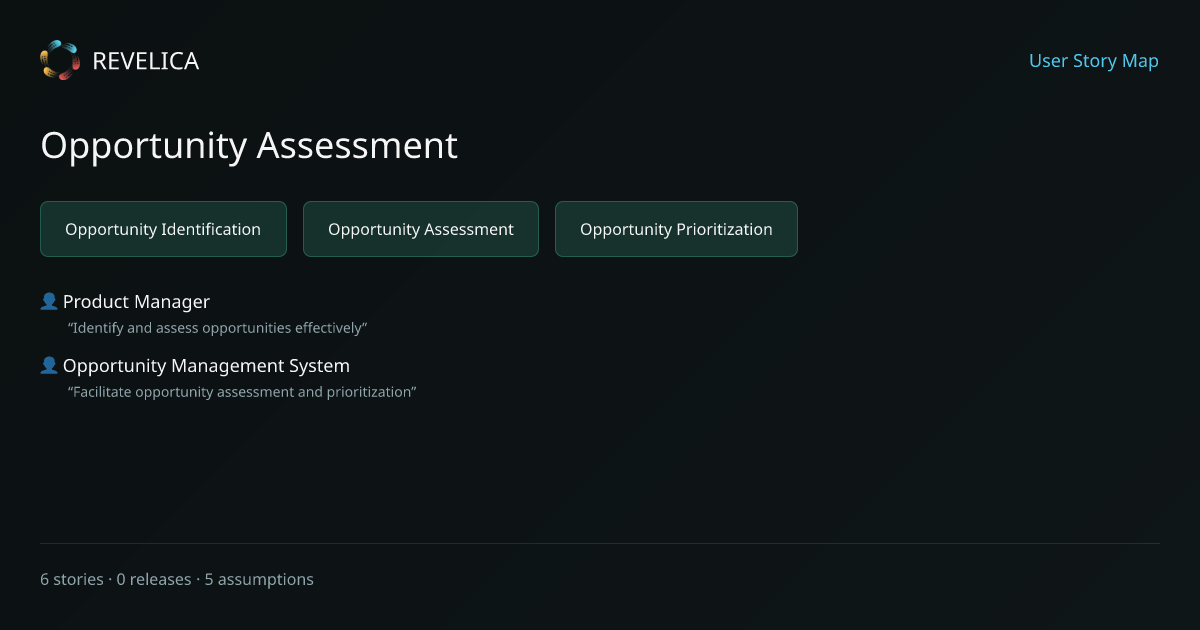
Opportunity Assessment
Great teams make roadmap decisions at the opportunity level, not the solution level. This playbook synthesizes data such as interview snapshots, customer mentions, potential impact on outcome, potential for margin, and competitive differentiation so you can confidently decide what customer problem to tackle next without spending 72 hours gathering data first.
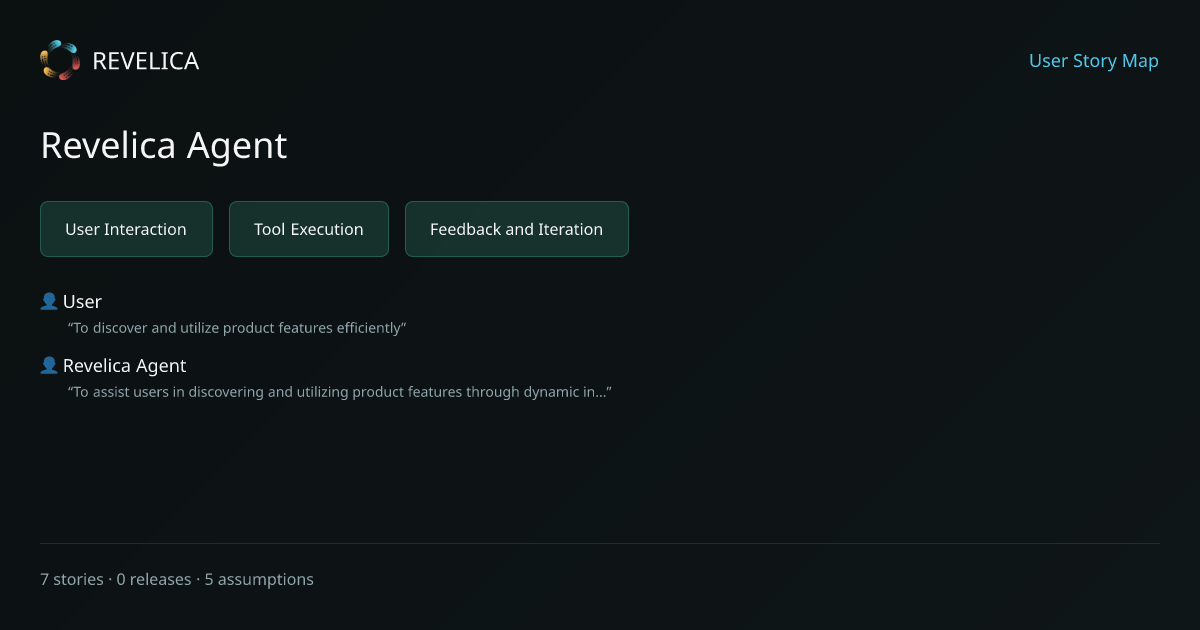
Revelica Agent
Talk to Revelica like you talk to Claude Code. Ask questions like "What competitors are we missing?" or "Brainstorm three solutions to this opportunity" and watch it use the platform tools while you observe and steer. Since it's important that product discovery data be reliable, our vision for a discovery agent is that it uses the existing well structured AI playbooks rather than working completely free form like other research agents.
Ok I get it, let me try for myself!
If you've ever had the dubious honour of listening to me drone on about product discovery, you probably know this is the playbook I coach on. You still need to talk to your customers, bring the vision, and execute with strategic focus. But at least now we've got a fighting chance of doing great discovery as fast as Claude Code helps us ship code.
Now that Revelica is in public beta, make your own free workspace, set up your strategic context, synthesize some customer research, and create your own shareable story maps in 15 minutes.
If you have any feedback along the way, just click the button in the Revelica sidebar. They go straight to our Slack. I can't help but drop what I'm doing to read them, even the hot takes.
You might be surprised how fast we ship something based on your feedback.
Randall